
Continue reading What is the Difference Between IGCSE and GCE O Level
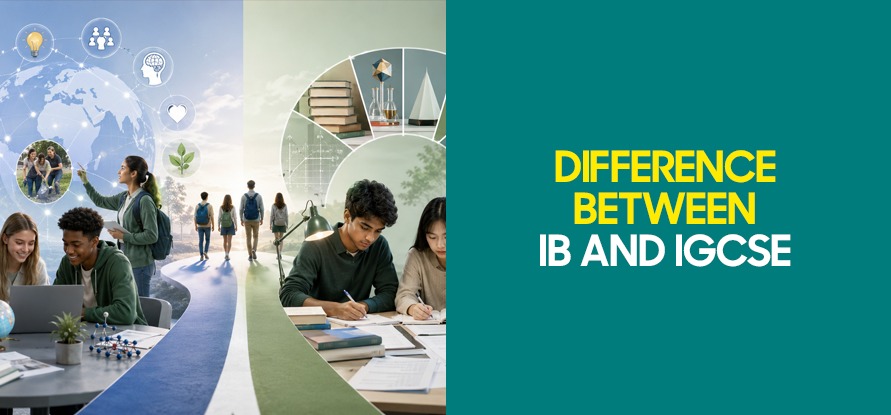
Picking the correct curriculum is a big part of a student’s academic career, especially in a place like the UAE, where many people come to study from other countries. The IB (International Baccalaureate) and IGCSE (International General Certificate of Secondary Education) are two of the most popular and well-known ways to study in the world. A lot of parents, students, and teachers want to know what the difference is between IB and IGCSE.
KaurOnlineEnglish full guide goes over both programs in detail, explaining how they work and helping you figure out which one could be better for your child, given their objectives, learning style, and plans for the future.
The International Baccalaureate (IB) is a program that is known all over the world for helping people become well-rounded, critical thinkers. It has different levels, but the IB Middle Years Programme (MYP) and the IB Diploma Programme (DP) for Grades 11–12 are the two that are most often contrasted. IB puts much focus on research, learning via questions, and personal growth.
Cambridge Assessment International Education made the IGCSE, which is usually taken in grades 9 and 10. It puts much emphasis on knowing your subject well, doing well in school, and taking tests. After finishing their IGCSEs, many students go on to A-Levels or other senior-school programs.
The IB structure encourages interdisciplinary thinking, while IGCSE allows students to specialise earlier.
IB Approach:
IGCSE Approach:
IB supports students who enjoy exploring ideas and connections. IGCSE suits those who prefer concrete subject understanding and exam-focused preparation.
IB Assessments:
IGCSE Assessments:
Students who are comfortable with long-term projects often excel in IB, while students confident in exam performance may prefer IGCSE.
IB Subjects:
This makes IGCSE ideal for early specialisation, especially for students planning careers in science, business, or technology.
Both qualifications are highly respected worldwide.
Universities appreciate IB students for their research and analytical skills, while IGCSE students often stand out for their strong academic fundamentals.
The UAE hosts thousands of international students, and both IB and IGCSE schools offer excellent opportunities. The “better” choice depends on:
Planning to study abroad in universities known for IB?
Planning to choose A-Levels later?
At KaurOnline English, we specialise in helping UAE-based students excel in both IB and IGCSE English. Whether your child needs support in essay writing, exam preparation, comprehension skills, or developing confident communication,
our expert tutors provide:
Our goal is to help every student succeed with clarity, confidence, and strong academic performance.
IB and IGCSE are both great international qualifications that have their own strengths. The main difference is how they teach: IB emphasises learning through inquiry and the whole person, whereas IGCSE focuses on building solid topic knowledge and getting pupils ready for advanced-level tests.
Choosing between them depends on the student’s goals, learning style, and future academic path. With the right guidance and support, students can excel in either curriculum.
Directed writing is an important part of the IGCSE English Language exam. It evaluates your ability to choose appropriate ideas, to structure a response, and to write for a particular audience and purpose.
You can be requested to write a letter, speech, article, report, email, or review. To score well, follow the directions, use an acceptable tone, develop your thoughts, and present them effectively.
Directed writing is writing for a particular goal, Audience, occasion, and format. Also, you can be provided with source material containing information to put in your answer.
The job is to understand the content, pick out useful parts, and turn them into good writing. The main talents are attentive reading, logical structure, proper tone, and precise expression.
Read the task at least twice and underline the key instructions. Ask yourself:
Use the PAF method:
P – Purpose A – Audience F – Format
A speech for younger students should sound friendly, while a report for a principal should be formal and factual.
Each type of writing has its own features. A formal letter needs a clear opening, organized paragraphs, polite language, and a suitable closing. A speech may include a greeting, direct address, rhetorical questions, and a memorable ending.
An article needs an engaging headline and a clear final message. A report should be objective and focused on findings and recommendations.
Spend a few minutes planning before writing. A simple outline prevents repetition and keeps your answer focused.
Include an introduction, two or three main points, and a conclusion. Use short notes rather than complete sentences.
If source material is provided, select only the ideas that answer the question. Avoid copying long sentences.
Highlight useful facts, separate positive and negative points, identify examples, and remove irrelevant information. Explain the selected ideas in your own words to show understanding.
Do not simply list ideas. Each paragraph should contain a main point, explanation, supporting detail, and link to the task.
Weak:
The school should provide more sports activities.
Developed:
The school should offer a wider range of sports because not every student enjoys football or basketball. Activities such as swimming and badminton would encourage more students to participate and improve their fitness.
The second version is stronger because it explains why the idea matters.
Tone may be formal, friendly, persuasive, serious, enthusiastic, or objective.
When writing to a principal, use respectful language:
I want to recommend several improvements to the school’s study areas.
When writing to a friend, you can sound more relaxed:
You should join the club because it is a great way to learn new skills and meet people.
Avoid slang in formal writing, but do not make a friendly article sound stiff.
Your introduction should make the purpose clear and lead directly into the topic.
Instead of a vague opening, write:
Our school library is a valuable learning space, but several changes are needed to make it more useful for students.
For a speech or article, a question can attract attention:
Have you ever wanted to learn a new skill while making new friends?
Each paragraph should focus on a single primary idea. Start a new paragraph when you introduce another point, shift from a problem to a solution, make a recommendation, or begin the conclusion.
Use linking phrases like firstly, in addition, nevertheless, consequently, for example, therefore, finally. Do not use the same linker again.
When persuasion is required, use rhetorical questions, direct address, emotive language, facts, examples, inclusive language, and groups of three.
Strong vocabulary means using accurate words, not simply difficult ones.
Instead of “The event was good,” write:
The event was enjoyable, well-organized, and educational.
Instead of “The problem was bad,” write:
The problem caused serious inconvenience for students and staff.
Avoid repeating basic words such as “good,” “bad,” “nice,” and “things.” Build vocabulary lists for common exam topics.
Use a mixture of short, medium, and longer sentences.
Short sentences create emphasis:
This must change.
Longer sentences explain ideas:
Although the current sports hall is useful, it is too small for the growing number of students who want to take part in after-school activities.
Sentence variety makes writing more engaging and demonstrates better control of English.
Leave a few minutes at the end to check your work. Look for missing capital letters, incorrect verb tenses, subject-verb agreement errors, repeated vocabulary, spelling mistakes, long sentences, and incorrect apostrophes.
If a sentence sounds confusing, rewrite it more simply. Clear and accurate writing is better than complicated writing filled with errors.
Divide your time into three stages:
Reading and planning: Understand the question and prepare an outline.
Writing: Follow your plan and answer the task.
Checking: Review grammar, spelling, punctuation, tone, and structure.
Do not spend too long creating a perfect introduction. Your main paragraphs contain most of the important ideas.
Regular practice is the best way to improve. Use past-paper questions from your examination board and complete them under timed conditions.
After writing, check whether you answered every part of the question, used the correct format and tone, developed your ideas, organized clear paragraphs, and used accurate language.
Ask a teacher or IGCSE English tutor to review your response and identify repeated mistakes.
To improve your directed writing skills, you need to practice regularly. Identify the goal, Audience, format, and tone of every task. Prepare your response, develop each point, organize your paragraphs, and use clear, precise language.
Review your errors on every practice task. Each correction will help you become a more confident writer.
Students in the UAE can join Kaur Online English for structured classes, exam-focused practice, and customized feedback.
Kaur Online English will help you to improve your IGCSE English Language skills and feel confident preparing for your exam.
This version is ready for use as an SEO blog post or educational website article.
Getting ready for the IGCSE exams in the UAE might be much work, especially since schools in Dubai, Abu Dhabi, and other places have high academic expectations. But if you get the correct help and make a good plan, you might feel more confident and greatly increase your chances of success. KaurOnlineEnglish is here to help you with this complete guide made just for students in the UAE, whether you want to get top grades or pass easily.
The International General Certificate of Secondary Education (IGCSE) is a globally respected qualification for students aged 14–16. Many UAE schools follow curricula from the major boards:
Cambridge Assessment International Education (CAIE) and Pearson Edexcel.
KaurOnlineEnglish helps students in the UAE decode this structure and tailor their study approach to match their specific exam board and school expectations.
In the UAE’s competitive academic environment, a smart preparation strategy is essential:
At KaurOnlineEnglish, we encourage students to take a goal-oriented, structured approach to exam prep, something especially helpful when managing busy school and tuition schedules in the UAE.
Assess your strengths and weaknesses using mock exams or feedback from your school teachers. UAE schools often provide mid-year benchmarks; use these to inform your plan.
Example: “Score at least an A in IGCSE Chemistry by revising for 45 minutes daily after school.” UAE students juggling extracurriculars can benefit from time-blocking their afternoons and evenings.
Sample Weekly Study Plan for IGCSE Preparation (UAE Students)
Use techniques like Pomodoro (25-minute study, 5-minute break) to stay focused. KaurOnlineEnglish tutors can help you set a realistic and adaptive timetable based on your specific school calendar.
KaurOnlineEnglish provides customized lessons in these core subjects, especially designed to suit students studying in the UAE education system.
Students across UAE schools benefit from KaurOnlineEnglish’s structured revision sessions, which include mock exams and examiner-style feedback.
Getting ready for the IGCSE in the UAE doesn’t have to be hard. You may do well on tests and in school with the correct tools, regular work, and help from KaurOnlineEnglish. If you live in Dubai, Abu Dhabi, Sharjah, or anywhere else in the area, you can trust KaurOnlineEnglish to help you do well on the IGCSE.

The IGCSE courses will help you to get fluent in English. KauronlineEnglish provides you with experienced IGCSE teachers for tests. Our teachers are the best and know how to do their work. We’ll give you expert teachers for perfecting your English. Our IGCSE online English language courses in Dubai will help you with English preparation. We give you the perfect training material for learning the English language. Kaur online English has the best teachers available for study and work.
Continue reading Kaur Online Has The Best Type of IGCSE Online English Language Courses in Dubai
The IGCSE courses will allow you to become fluent in English. Kauronline provides you with the best IGCSE tutors for exam preparation. Our tutors are the best and know well how to do their work. We will provide you with the best tutors for improving your English skills. Our IGCSE Online English language courses in Dubai will help you to prepare for your English and excel in academics. We provide you with the best training material for learning the English language. Kaur online English has the best tutors available for study and work.
Continue reading Kaur Online Has The Best IGCSE Online English Language Courses in Dubai
The IGCSE courses will allow you to become fluent in English. Kaur online provides you with the best IGCSE tutors for exam preparation. Our tutors are the best and know well how to do their work. We will provide you with the best tutors for improving your English skills. Our IGCSE Online English language courses Dubai will help you to prepare for your English and excel in academics. We provide you with the best training material for learning the English language. Kaur Online English has the best tutors available for study and work.
Continue reading Kaur Online Has The Best IGCSE Online English Language Courses Dubai


